Can AI Be a Patent Inventor? The Global Debate on AI Inventorship
When an AI system autonomously designs a new drug molecule, a novel material composition, or a mechanical device, who is the inventor? Patent law has always assumed a human answers that question. That assumption is now being tested in courts and patent offices worldwide.
The DABUS Cases — A Global Test
What is DABUS?
DABUS (Device for the Autonomous Bootstrapping of Unified Sentience) is an AI system created by Stephen Thaler. Thaler filed patent applications in multiple countries naming DABUS as the sole inventor of two inventions: a food container with a fractal surface for improved grip and heat transfer, and a light beacon that flashes in a pattern designed to attract attention during emergencies.
The inventions themselves are unremarkable. The inventorship claim is what made these applications a global legal test case.
Results by jurisdiction
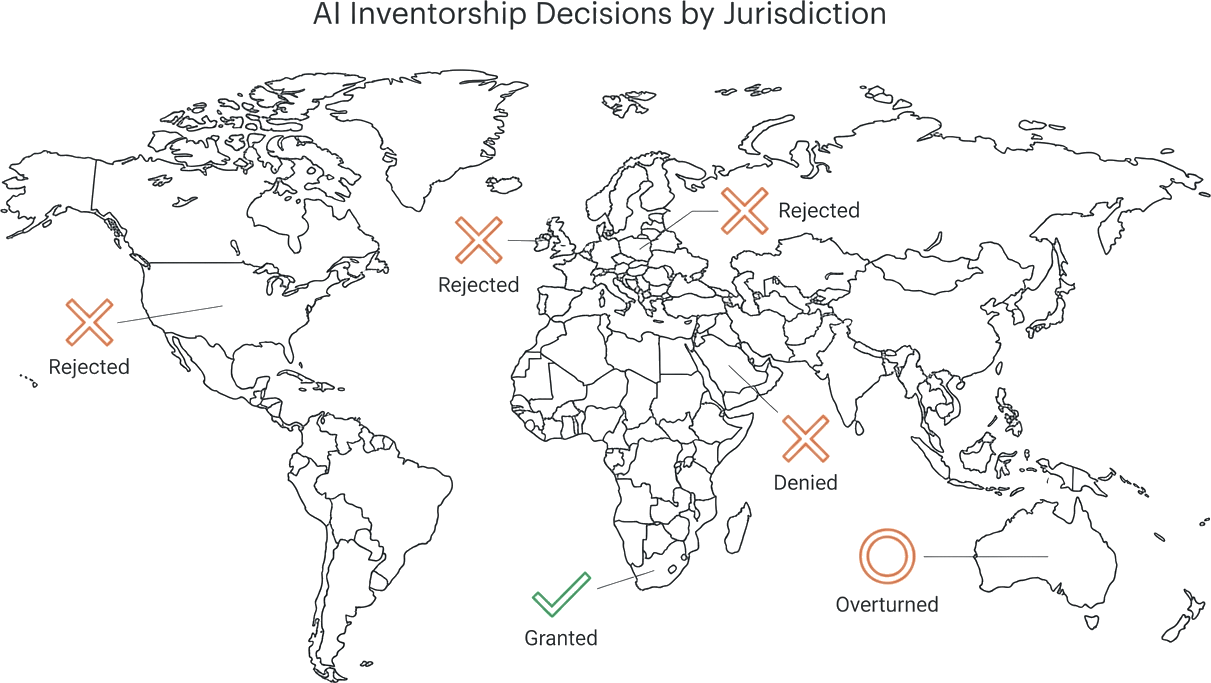
Thaler filed in over a dozen countries. The results form a map of how the world’s patent systems handle AI inventorship:
| Jurisdiction | Decision | Reasoning |
|---|---|---|
| United States | Rejected | Thaler v. Vidal (Fed. Cir. 2022): the Patent Act uses “individual” to describe an inventor, and under established law, “individual” means a natural person. SCOTUS declined to hear the appeal. |
| United Kingdom | Rejected | UKSC (2023): UK law requires an inventor to be a natural person. The court noted that Parliament, not courts, should decide whether to expand inventorship to AI. |
| EPO | Rejected | The EPO Board of Appeal confirmed that EPC Art. 81 and Rule 19(1) require a natural person as inventor. An AI system cannot hold rights or transfer them. |
| Australia | Initially allowed, then overturned | The Federal Court initially ruled DABUS could be listed as inventor. The Full Federal Court reversed, and the High Court of Australia denied special leave to appeal in November 2022, confirming that an inventor must be a natural person under Australian law. |
| South Africa | Granted | South Africa does not conduct substantive examination. The patent was granted without any assessment of whether an AI can legally be an inventor. |
| Saudi Arabia | Initially accepted, then denied | SAIP initially allowed the application but subsequently refused it, leaving South Africa as the only jurisdiction where a DABUS patent remains on the register. |
The pattern is clear: every jurisdiction that conducted substantive legal analysis concluded that current law requires a human inventor.
Why This Matters
Ownership gap
If AI cannot be an inventor, and no human contributed the inventive conception, the invention falls into a legal void. Under current law, it may be unpatentable — not because it lacks novelty or non-obviousness, but because there is no qualifying inventor to name.
This creates a practical problem for companies investing heavily in AI-driven R&D. If an AI system screens 10 million molecular candidates and identifies a novel compound without meaningful human direction of the inventive concept, who files the patent? The company? The person who pressed “run”? Under current rules, the answer is unclear.
Disclosure incentive
The patent system operates on a trade: you disclose your invention publicly, and in exchange you get a limited monopoly. This incentive structure assumes the inventor values the monopoly. An AI system does not. If AI-generated inventions cannot be patented, companies may choose trade secrecy over disclosure, reducing the public knowledge base that the patent system is designed to build.
Innovation policy
Strict inventorship requirements could discourage investment in AI-assisted R&D. If a company cannot protect AI-generated innovations, the return on that investment drops. Conversely, allowing AI inventorship raises questions about patent flooding — AI systems could generate thousands of patent applications, overwhelming the examination system and creating thickets of rights that impede rather than promote innovation.
Current Legal Frameworks
United States
Under 35 U.S.C. §100(f), “the term ‘inventor’ means the individual or, if a joint invention, the individuals collectively who invented or discovered the subject matter of the invention.” The Federal Circuit in Thaler v. Vidal, 43 F.4th 1207 (Fed. Cir. 2022), confirmed that “individual” means a natural person, and the Supreme Court denied certiorari in April 2023. The USPTO issued Inventorship Guidance for AI-Assisted Inventions in February 2024 (89 Fed. Reg. 10043), which required a natural person to have made a “significant contribution” to each claim under the Pannu factors. That guidance was revised and superseded in November 2025, moving away from the Pannu factors approach toward a broader evaluative framework for how the agency assesses AI-assisted inventorship.
Europe
EPC Art. 81 requires that patent applications designate the inventor. Rule 19(1) requires the designation to include the inventor’s family name, given names, and full address — fields that presuppose a human. The EPO Guidelines for Examination state explicitly that an inventor must be a natural person.
China
China’s Patent Law requires that an “inventor” be a person who makes “creative contributions” to the substantive features of the invention. The term is understood to mean a natural person, though China has not yet faced a high-profile test case equivalent to DABUS.
Emerging proposals
WIPO has convened multiple sessions on AI and IP policy, producing discussion papers but no binding recommendations. The USPTO published a Request for Comments on AI and inventorship in 2023, and in February 2024 issued guidance confirming that AI-assisted inventions remain patentable provided a natural person made a significant contribution to each claim. That guidance was revised and superseded in November 2025, moving away from the Pannu factors approach toward a broader evaluative framework. Several academic proposals suggest creating a new category of “AI-assisted” or “AI-generated” inventions with different rules — shorter terms, reduced fees, or compulsory licensing requirements — but none have been adopted.
Practical Guidance for AI-Assisted Inventions
While the law evolves, companies and inventors using AI in their R&D processes should follow these practices:
Document human contributions carefully
Keep records of every stage where a human made inventive decisions: defining the problem, setting parameters, selecting which AI outputs to pursue, modifying the AI’s results, and conceiving the final solution. These records establish that a natural person contributed to the invention.
Name the human who directs and conceives
The person who formulates the problem, guides the AI, and exercises judgment about the output can generally be named as inventor, provided their contribution rises to the level of inventive conception. Using AI as a tool does not disqualify you as inventor — just as using a calculator does not disqualify a mathematician.
Position AI as a tool, not a co-inventor
In patent applications and prosecution, describe AI as an instrument used in the inventive process. “The inventor used machine learning to screen candidate compounds” is safe. “The AI system invented the compound” is not.
How GoVeda Fits In
GoVeda uses AI to assist patent research — searching, summarizing, analyzing, and comparing patents. The inventive decisions remain entirely with the human user. You direct the search, evaluate the results, and decide what to do with them. GoVeda’s AI is a tool that makes your work faster and more thorough, not a replacement for human judgment.
Explore AI-powered patent research on GoVeda →
Disclaimer: This article is provided for general information only and does not constitute legal advice. AI inventorship law is evolving rapidly and varies significantly by jurisdiction — consult qualified patent counsel before making inventorship or filing decisions on AI-assisted inventions.