What Is Prior Art? A Complete Guide for Inventors and IP Professionals
Prior art is any evidence that your invention was already known before you filed a patent application. It includes patents, academic papers, product manuals, public demonstrations, sales, and even oral presentations. If the idea existed in the public domain before your effective filing date, it counts.
That definition sounds simple. Applying it is not.
What Counts as Prior Art?
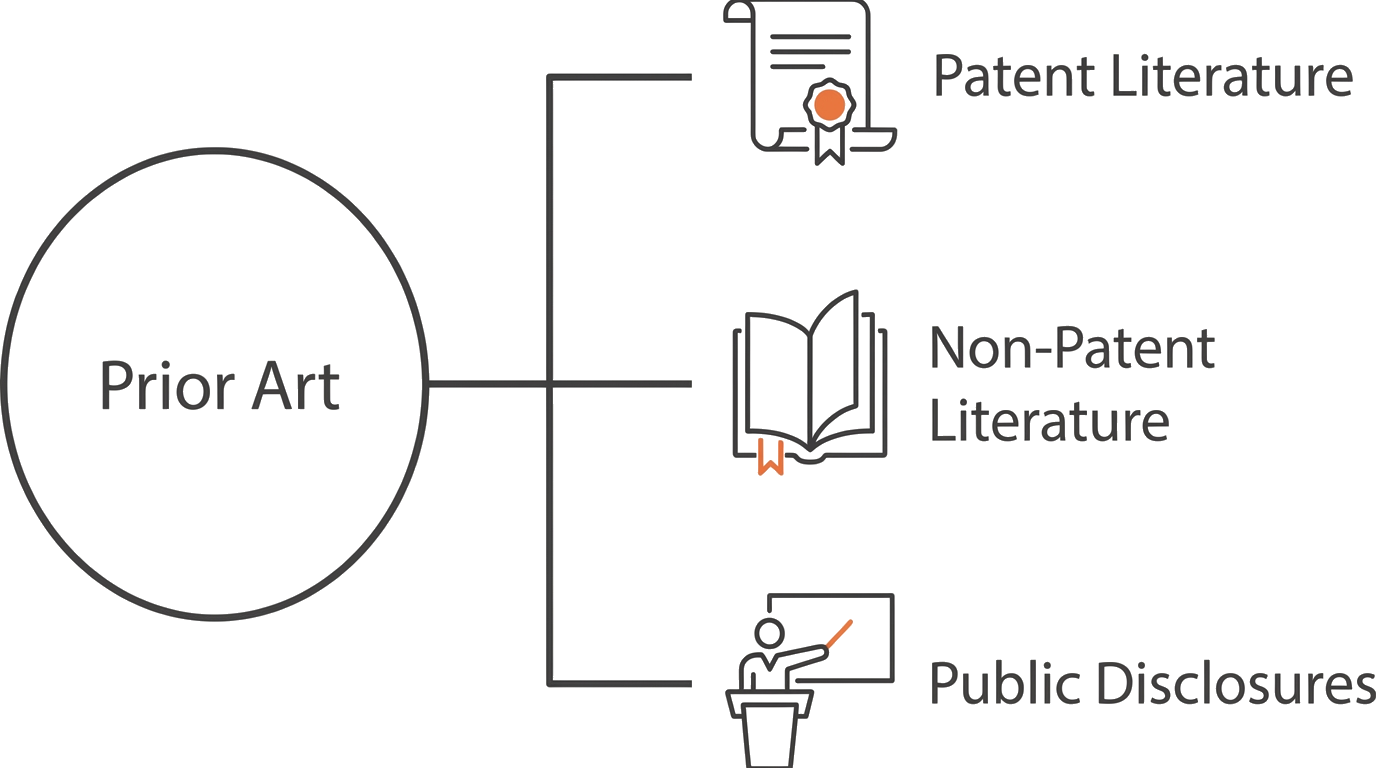
Published patent documents
Granted patents, published applications, and PCT filings from any country qualify as prior art. The document does not need to be in English, and it does not need to have resulted in a granted patent. A 1998 Japanese patent application describing a similar mechanism counts, even if it was never granted.
US provisional applications are never published on their own. A provisional only enters the prior art universe indirectly — when a later non-provisional or PCT application claims its benefit and is itself published, the provisional’s filing date can become the effective prior art date for the disclosed subject matter under 35 U.S.C. §102(a)(2) and (d).
Non-patent literature
Academic papers, conference proceedings, product manuals, technical standards, white papers, dissertations, and online publications all qualify. An IEEE paper from 2015 describing the same algorithm is prior art.
Non-patent literature is routinely underestimated. Patent examiners at the USPTO and EPO increasingly cite it in rejections, especially in software, biotech, and materials science. If a peer-reviewed journal published your method three years before you filed, your patent is dead on arrival.
Public use, sales, and oral disclosures
Under 35 U.S.C. §102(a)(1), prior art includes anything that was “patented, described in a printed publication, or in public use, on sale, or otherwise available to the public” before the effective filing date. A product demo at CES, a sale to a single customer, or an oral presentation at an industry conference can all destroy novelty.
The bar is lower than most inventors expect. A YouTube video with twelve views showing your device in operation? Prior art.
The critical date
The effective filing date (or priority date, if you claimed priority from an earlier application) determines the dividing line. Anything publicly available before that date is prior art against your claims. Anything after is not.
Get this wrong and nothing else matters. If you misidentify your priority date, your entire search is built on the wrong foundation.
Grace period
Not every jurisdiction treats the filing deadline the same way. Grace periods allow inventors to disclose their own invention publicly and still file a patent within a limited window. But the rules vary dramatically.
| Jurisdiction | Grace Period | Rule |
|---|---|---|
| United States | 12 months | Inventor’s own disclosures don’t count as prior art within 12 months before filing (35 U.S.C. §102(b)(1)) |
| Europe (EPO) | 6 months (very limited) | Effectively absolute novelty (EPC Art. 54). Narrow exceptions exist only for evident abuse by a third party or display at an officially recognized international exhibition (EPC Art. 55) |
| China (CNIPA) | 6 months (limited) | Chinese Patent Law Art. 24 — only applies to first disclosure at a government-approved international exhibition, a prescribed academic/technical conference, unauthorized disclosure by others, or disclosure for public-interest purposes during a declared national emergency |
| Japan (JPO) | 12 months | Similar to US but requires filing a specific exception request |
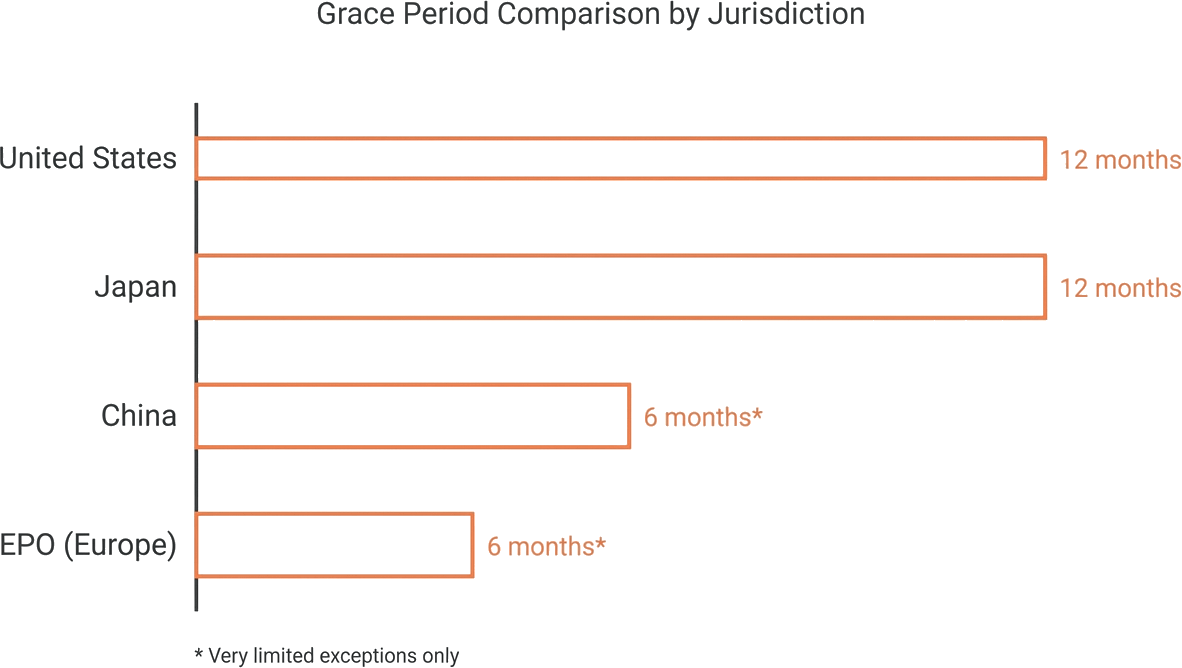
This is where it gets dangerous. A biotech founder presents preliminary results at an academic conference in March. She files a US patent in November, still within the 12-month window. But her European filing? Out of luck entirely. The EPO’s narrow grace period (EPC Art. 55) only covers evident abuse by third parties and display at officially recognized international exhibitions — academic conferences are never covered, regardless of timing. The presentation destroyed novelty under EPC Art. 54. One conference talk, and she lost patent protection in one of the world’s largest markets.
If you plan to file internationally, treat the EPO’s absolute novelty standard as your default. File before you disclose. Always.
First-to-file vs. first-to-invent
The America Invents Act (AIA), effective March 16, 2013, moved the United States from a first-to-invent system to first-inventor-to-file. Who conceived the invention first no longer matters. What matters is who filed the patent application first. Every major patent jurisdiction now operates on a first-to-file basis.
Why Prior Art Matters
Patentability
To receive a patent, your invention must be novel (35 U.S.C. §102) and non-obvious (35 U.S.C. §103). A single prior art reference that discloses every element of your claim anticipates it and destroys novelty outright. Even if no single reference matches, a combination of references can render your invention obvious. An examiner will reject it under §103.
This is where most patent applications fail. Usually because something too similar already existed.
Patent invalidation
Prior art is the primary weapon for invalidating granted patents. In Inter Partes Review (IPR) proceedings before the Patent Trial and Appeal Board (PTAB), challengers can petition to invalidate claims — but only on grounds of prior art patents and printed publications under 35 U.S.C. §311(b). Other invalidity grounds (such as §101 subject matter or §112 written description) are not available in IPR, which is why strong prior art is the foundation of almost every petition.
IPR has become the preferred venue for companies facing patent infringement suits. It is faster and cheaper than district court litigation, and the burden of proof is lower — preponderance of the evidence rather than the clear-and-convincing standard required in district court. If prior art exists that the original examiner missed, IPR is where it surfaces.
Freedom-to-operate
Before launching a product, companies conduct freedom-to-operate (FTO) analyses to determine whether their product infringes existing patents. Prior art plays a dual role: it defines the boundaries of competitors’ patent claims, and it can narrow or invalidate claims that would otherwise block your product. A strong prior art position can be the difference between a launch and a redesign.
How to Search for Prior Art
Keyword search vs. semantic search
Traditional keyword search matches exact terms. You type “foldable display,” and it returns documents containing those words. The problem: patent drafters use inconsistent terminology across jurisdictions and decades. “Flexible screen apparatus,” “bendable panel device,” and “collapsible display mechanism” all describe the same thing but won’t match a keyword query for “foldable display.”
Semantic search uses AI models to match meaning rather than words. You describe the concept in plain language, and the system finds documents about the same idea regardless of the specific phrasing used. For prior art searches, this eliminates the biggest source of false negatives.
Classification-based search (CPC/IPC codes)
Every patent is assigned classification codes under the Cooperative Patent Classification (CPC) or International Patent Classification (IPC) system. Searching by code lets you find all patents in a specific technology area without relying on keywords. This is especially useful for broad landscape searches or when you need to understand the density of filings in a particular domain.
Citation tracing
Forward citations show which later patents cited a given reference. Backward citations show what that patent itself cited. Walking the citation graph in both directions often uncovers highly relevant prior art that keyword and classification searches miss entirely. If one relevant patent cites three others, those three are worth reading.
Common Mistakes in Prior Art Searches
Most prior art searches fail not because the prior art doesn’t exist, but because the searcher didn’t look in the right places.
The most common failure is searching too narrowly. Using a single query with specific technical terms and calling it done. Effective searches require multiple queries, synonyms, and alternative phrasings. If you only searched one way, you didn’t search enough.
Then there’s the language problem. Over half of the world’s patent documents are in languages other than English. Chinese and Japanese patent offices publish millions of documents that never appear in English-language databases. Ignoring them creates a blind spot that competitors will exploit. A patent glossary can help you identify equivalent terms across jurisdictions, but you still need tools that search across languages.
Ignoring non-patent literature is another recurring mistake. Examiners are required to consider it. You should too. A PhD thesis from 2008 sitting in a university repository can invalidate a patent just as effectively as a granted US patent.
And most people stop too early. The first ten results are rarely sufficient. Prior art searches are iterative. Each relevant document you find should generate new search terms and new directions.
How GoVeda Simplifies Prior Art Search
GoVeda’s semantic AI search covers 220M+ patent documents across 108 jurisdictions. You describe your invention in plain language, without boolean strings or keyword guessing, and GoVeda returns semantically relevant results ranked by similarity to your concept. The system matches across languages automatically, so a Chinese utility model or a Japanese published application surfaces alongside US and European patents without requiring separate searches or translations.
Try GoVeda’s prior art search for free
Disclaimer: This article is provided for general information only and does not constitute legal advice. Patent law is jurisdiction-specific and fact-sensitive — consult qualified patent counsel before acting on any of the statutes, cases, or strategies discussed here.