Why We Built GoVeda
Patent search has not changed much in three decades. The tools got faster. The databases got bigger. But the fundamental approach — type keywords, scroll through results, read documents one by one — remained the same. We built GoVeda because we think that approach is broken, and AI makes a better one possible.
The Problem
Patent search is slow, expensive, and requires deep expertise
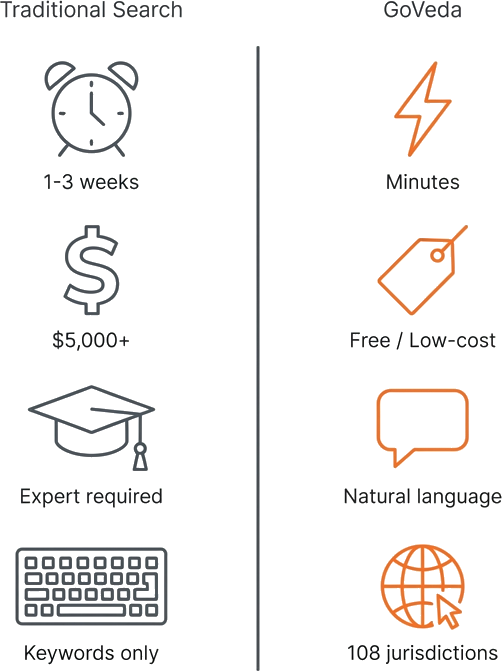
A professional prior art search costs $1,500 to $5,000 and takes one to three weeks. A freedom-to-operate analysis costs $5,000 to $15,000. These are not luxury services — they are routine steps in the patent process. But the cost and timeline mean that many inventors, startups, and small companies skip them entirely, or do a quick keyword search and hope for the best.
The expertise requirement compounds the problem. Effective patent searching requires knowledge of Boolean query construction, patent classification systems (CPC, IPC), jurisdiction-specific search syntax, and enough technical depth to evaluate the results. Most inventors do not have this skill set. They are experts in their technology, not in patent databases.
Traditional databases rely on keyword matching
Keyword search finds patents that use the exact words you typed. It does not find patents that describe the same concept using different terminology. In a field like autonomous driving — where the same technology appears as “self-driving,” “driverless,” “unmanned vehicle,” “automatic vehicle control,” and dozens of foreign-language equivalents — keyword search misses a significant portion of relevant results.
This is not a minor gap. Studies of patent search recall show that even professional examiner searches routinely fall short of full recall, and the shortfall widens across jurisdictions and time periods where terminology has evolved — precisely the conditions under which semantic approaches add the most value.
Growing volume makes manual search unsustainable
There are over 220 million published patent documents worldwide. Thousands more are published every day. In fast-moving fields like AI, batteries, and biotech, the volume of relevant prior art is growing faster than any human can track manually. Even experienced patent professionals cannot keep up with the firehose.
Our Approach
AI-native from day one
GoVeda is not a traditional patent database with an AI feature bolted on. Semantic search is the foundation. When you describe your invention in plain language, our embedding models find patents with similar concepts regardless of terminology. This is a fundamentally different approach from keyword matching, and it catches what keyword search misses.
Coverage matters
220M+ patents across 108 jurisdictions. Not just the big five patent offices (USPTO, EPO, CNIPA, JPO, KIPO), but also India, Brazil, Southeast Asia, and others. Patent protection is global, and patent search should be too. A relevant prior art reference filed at the Indian Patent Office is just as lethal to your application as one filed at the USPTO.
Accessible to everyone
We designed GoVeda for inventors, engineers, and R&D teams — not just patent attorneys and professional searchers. The interface accepts natural language. The results are ranked by relevance. AI summaries explain what each patent covers in plain terms. You do not need to learn Boolean syntax or classification taxonomies to get useful results.
This does not mean GoVeda replaces professional IP counsel. It means that by the time you engage your patent attorney, you already have a clear picture of the prior art landscape, and the conversation is more productive.
What We’ve Built
Semantic search
Describe your invention or technology area in plain language. GoVeda searches 220M+ patents and returns results ranked by semantic similarity. No Boolean queries required.
Patent Chat
Open any patent and ask questions about it in natural language. “What does claim 1 cover?” “How does this differ from my invention?” “What materials are specified in the description?” Patent Chat reads the full document and answers with citations to specific passages. See Introducing Patent Chat for details.
Patentability Reports
Describe your invention and get an AI-generated novelty analysis in minutes. The report identifies the most relevant prior art, compares it to your invention, and provides a novelty verdict with recommendations. See From Idea to Report in 5 Minutes for a walkthrough.
MCP + API
For developers and power users, GoVeda exposes its tools through an MCP server and REST API. Connect Claude, ChatGPT, or any MCP-compatible client to search patents, retrieve content, and generate reports programmatically. See Building Patent Workflows with MCP + Claude for setup and examples.
Who GoVeda Is For
Inventors validating ideas. Before you invest months of development and tens of thousands of dollars in patent prosecution, find out if your idea is actually new. A 5-minute search can save you from pursuing an invention that already exists.
IP professionals conducting prior art searches. Supplement your keyword and classification searches with semantic search to catch what traditional methods miss. Use AI reports as a starting point for client deliverables.
R&D teams mapping technology landscapes. Understand who is patenting what in your technology area. Identify whitespace opportunities and competitive threats.
Developers building patent-aware applications. Use the API or MCP server to integrate patent intelligence into your own tools and workflows.
What’s Next
We are expanding coverage, improving search quality, and building new analysis features. The goal is the same as it was when we started: make patent intelligence fast, accurate, and accessible to everyone who needs it.
Disclaimer: GoVeda is an informational tool and does not constitute legal advice. AI-generated search results and reports are intended to support — not replace — professional patent analysis. Consult qualified patent counsel before making filing, prosecution, or enforcement decisions.