Patent Number Formats Explained: A Quick Reference Guide
A patent number like “US11234567B2” looks cryptic, but it follows a consistent structure. Understanding that structure is a prerequisite for searching patent databases, citing prior art, and tracking a patent through its lifecycle.
Anatomy of a Patent Number
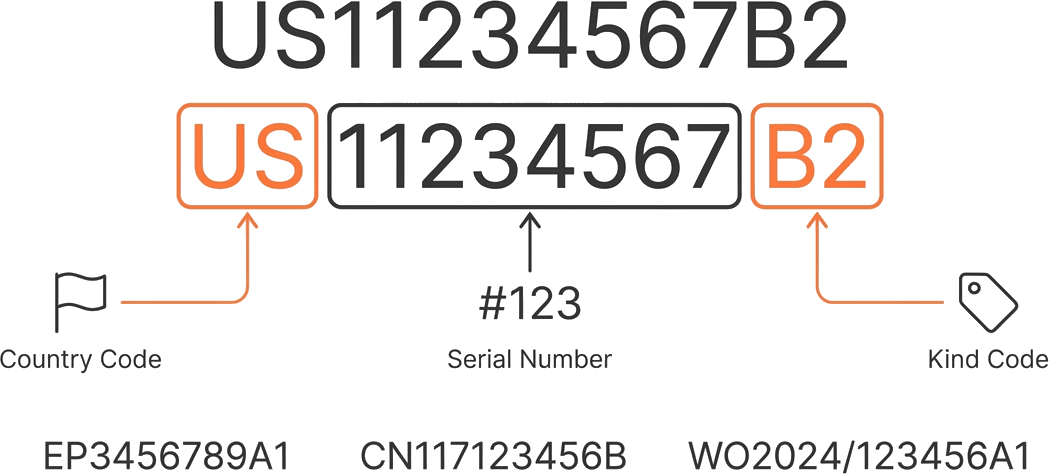
Every published patent document has a publication number with three parts:
Country code + Serial number + Kind code
Take US11234567B2:
- US — Country code (United States)
- 11234567 — Serial number (unique identifier assigned by the patent office)
- B2 — Kind code (document type — in this case, a granted patent that went through pre-grant publication)
The country code follows the WIPO ST.3 standard — a two-letter code identifying the patent office. The serial number format varies by office. The kind code tells you what stage the document is at.
Common Kind Codes
Kind codes are the most confusing part of patent numbers. The same patent can generate multiple documents at different stages — application, publication, grant — and each gets a different kind code.
USPTO (United States)
| Kind Code | Meaning |
|---|---|
| A1 | Published patent application (pre-grant publication) |
| B1 | Granted patent (no pre-grant publication — rare after 2000) |
| B2 | Granted patent (with prior pre-grant publication) |
| S1 | Design patent |
| P2 | Plant patent — published application |
| P3 | Plant patent — granted |
EPO (European Patent Office)
| Kind Code | Meaning |
|---|---|
| A1 | Published application with search report |
| A2 | Published application without search report |
| A3 | Search report published separately |
| B1 | Granted patent |
| B2 | Amended granted patent (after opposition) |
WIPO (PCT International)
| Kind Code | Meaning |
|---|---|
| A1 | International publication with international search report |
| A2 | International publication without international search report |
CNIPA (China)
| Kind Code | Meaning |
|---|---|
| A | Published invention application |
| B | Granted invention patent |
| U | Granted utility model |
| S | Design patent (kind codes for Chinese design patents have varied over time; verify against the current CNIPA authority file for the specific document) |
JPO (Japan)
| Kind Code | Meaning |
|---|---|
| A | Published unexamined patent application (kōkai tokkyo kōhō) |
| B1 | Granted patent without prior “A” unexamined publication (less common today but still assigned) |
| B2 | Granted patent published after a prior “A” unexamined publication (the standard form for modern grants) |
| U | Published utility model |
Note: Japan restructured its kind codes when it moved from pre-grant publication of examined applications to the current system. Most patents granted today appear as “B2”.
Major Patent Office Formats
USPTO
Granted patents use a 7- or 8-digit serial number + kind code. Application publications use a year prefix + 7-digit sequence.
- Application publication: US2024/0123456A1 (or US20240123456A1)
- Granted patent: US11,234,567B2 (or US11234567B2)
- Design patent: USD1,234,567S1 (note the “D” prefix for design patents)
The USPTO switched from 7-digit to 8-digit grant numbers when it exceeded US9,999,999 in June 2018. Application publication numbers follow a separate format with a 4-digit year prefix.
EPO
Format: EP + up to 7 digits + kind code (older EP numbers may have fewer digits, zero-padded in some databases)
- Application: EP3456789A1
- Granted patent: EP3456789B1
The same EP number is used throughout the lifecycle — only the kind code changes.
WIPO (PCT)
Format: WO + year + 6 or 7 digits + kind code
- WO2024/123456A1 (6-digit serial)
- WO2024/1234567A1 (7-digit serial, used for higher-volume years since 2004)
The year indicates when the international application was published, not when it was filed. PCT applications always start with WO. WIPO transitioned from 6- to 7-digit serial numbers as filing volume grew.
CNIPA (China)
Format: CN + serial + kind code
- Published application: CN117123456A
- Granted patent: CN117123456B
- Utility model: CN217123456U
Chinese patent numbers have grown longer over the years as filing volume increased.
JPO (Japan)
Format: JP + serial + kind code
- Published application: JP2024-123456A
- Granted patent: JP7123456B2
Japan uses a year-serial format for applications and a sequential number for grants. Note: pre-2000 Japanese patent documents used the Japanese imperial year (e.g., Heisei, Showa) instead of the Western calendar year, which affects searches of older Japanese patents.
Application Numbers vs. Publication Numbers
This distinction trips up many people. A single patent generates multiple numbers during its lifecycle:
- Application number — Assigned when the application is filed. Used internally by the patent office to track the case. Format varies by office.
- Publication number — Assigned when the application is published (typically 18 months after filing). This is the number you see on the published document.
- Patent number (grant number) — Assigned when the patent is granted. In the US, this is a separate number (e.g., US11,234,567). At the EPO, the same number is reused with a different kind code (EP3456789A1 becomes EP3456789B1).
When citing prior art or searching databases, use the publication number — it is the most universally recognized identifier. When checking legal status, you may need the application number to query the patent office’s register.
A patent family (the same invention filed in multiple countries) generates different publication numbers in each jurisdiction. EP3456789, US11234567, CN117123456, and JP7123456 might all cover the same invention. Patent family databases link these together.
How to Look Up Patents by Number on GoVeda
GoVeda’s Patent Viewer accepts publication numbers in any standard format. Enter “US11234567B2” or “EP3456789A1” or “CN117123456A” and the system retrieves the full document with structured sections for details, summary, PDF, family, legal status, and citations.
You do not need to worry about formatting — GoVeda normalizes the input. “US 11,234,567” and “US11234567B2” both work.
Look up a patent number on GoVeda →
Disclaimer: Patent number and kind code conventions change over time and vary by office. This article reflects common practice but should not be relied upon for authoritative legal citation — verify any specific document against the issuing office’s official records.