How to Read a Patent Document: A Beginner’s Guide
A typical patent document runs 20 to 80 pages. Some exceed 200. They are written in a hybrid of technical language and legal formalism that is deliberately precise and often impenetrable. The good news: you do not need to read every word. You need to know which parts matter and in what order to read them.
The Structure of a Patent Document
Title
One line summarizing the invention. Titles are intentionally broad — “System and method for data processing” could describe almost anything. The title is useful for quick scanning during search results but tells you little about the actual invention.
Abstract
A concise summary (limited to 150 words under USPTO rules) of what the invention does and how it works. The abstract appears on the front page of the published document. It carries no legal weight — courts do not use the abstract to interpret claims — but it is the fastest way to decide whether a patent is worth reading further.
Thirty seconds with the abstract should answer one question: is this patent potentially relevant to what I am looking for? If yes, keep reading. If no, move on.
Drawings/Figures
Most patents include figures — block diagrams, flowcharts, circuit schematics, mechanical drawings, or screenshots. The figures are often more informative than the text. A block diagram showing data flow between components can convey in one page what the description takes ten pages to explain.
Figures are numbered (FIG. 1, FIG. 2, etc.) and referenced throughout the description. If you are trying to understand what the invention actually does, start with the figures.
Description/Specification
The longest section. The description explains the invention in enough detail that someone skilled in the field could reproduce it. It typically includes:
- Background — What problem does the invention solve? What prior approaches exist and what are their limitations?
- Summary — Brief overview of the invention’s key aspects
- Detailed description — The full technical explanation, referencing the figures
The description is important for understanding the invention in depth, but most of its content serves a supporting role. Courts use the description to interpret the claims, but the description itself does not define the scope of protection.
Claims
The most important section. Claims define the legal boundaries of the patent — what is protected and what is not. They appear at the end of the document as numbered paragraphs, each a single (often very long) sentence.
If you are evaluating whether a product infringes, whether prior art invalidates a patent, or what an applicant is actually trying to protect, the claims are where you find the answer. For a detailed treatment, see Understanding Patent Claims.
Where to Start Reading
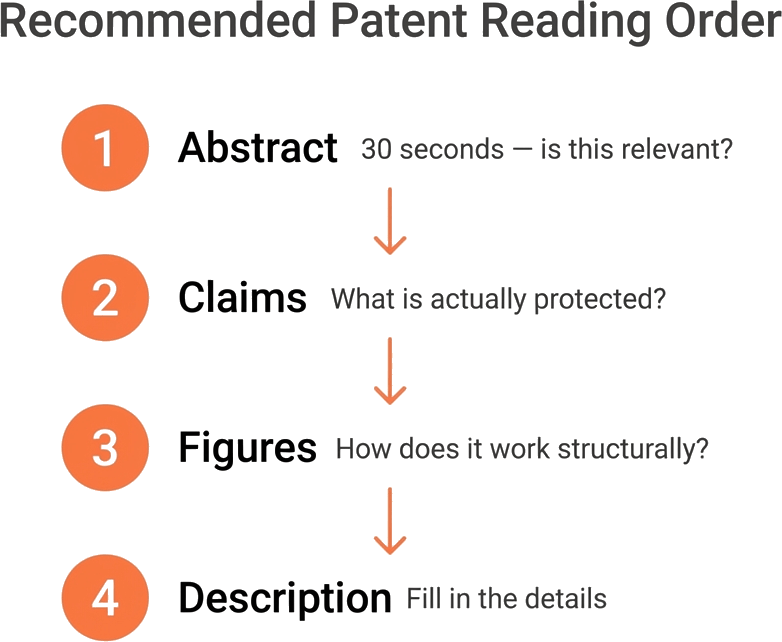
Do not read a patent front-to-back like a research paper. Use this order:
- Abstract — 30 seconds. Is this patent relevant? If not, stop.
- Claims — Start with claim 1 (the broadest independent claim). What is actually being protected? Identify the key elements and limitations.
- Figures — Look at the main diagrams. How does the invention work at a structural level?
- Description — Read the detailed description only when you need to understand specific elements or when the claims use terms that need clarification.
This order prioritizes the information that matters most. The abstract filters for relevance. The claims tell you what is protected. The figures give you spatial and structural understanding. The description fills in the details.
How to Read Claims
Start with independent claim 1. It defines the broadest scope of protection. Read it slowly — each word matters.
Break the claim into its individual elements. A method claim might have five steps. A system claim might have four components. List them. Then identify the limitations: what constraints does each element impose?
Check the dependent claims. They narrow the independent claim by adding additional requirements. Dependent claim 3 might add “wherein the processor is a GPU.” That narrows the scope but also provides a fallback position if the broader independent claim is invalidated.
For a detailed guide to claim structure, transitional phrases, and claim types, see Understanding Patent Claims.
Reading Efficiently at Scale
When conducting a prior art search, you may face hundreds of potentially relevant patents. Reading every one in full is not feasible. Use a triage approach:
First pass — abstracts only. Scan the abstract of each result. Sort into three buckets: clearly relevant, possibly relevant, and not relevant. This pass takes 15-30 seconds per patent.
Second pass — claims and figures. For the “clearly relevant” and “possibly relevant” buckets, read the independent claims and look at the key figures. This pass takes 2-5 minutes per patent. Most patents will drop out of consideration here.
Third pass — full read. For the handful of patents that remain after the first two passes, read the full description. Map their disclosures against your invention or product. This pass takes 15-30 minutes per patent.
AI summaries can accelerate the first pass significantly. Instead of reading hundreds of abstracts yourself, use AI-generated summaries to triage faster.
How GoVeda Makes Patent Reading Easier
GoVeda’s Patent Viewer presents each patent in a structured interface with sections for Details, Summary, PDF, Family, Legal Status, and Citations. Instead of scrolling through a monolithic PDF, you navigate directly to the section you need.
The AI-generated summary provides a plain-language overview of what the patent covers — useful for the triage phase of large-scale searches.
Patent Chat lets you ask questions about any patent in natural language. “What does claim 1 cover?” “What problem does this patent solve?” “Does this patent describe [a specific mechanism]?” The AI reads the full document and responds with citations to the relevant passages, so you can verify every answer against the source text.
Read your first patent on GoVeda →
Disclaimer: This article is provided for general information only and does not constitute legal advice. Consult qualified patent counsel before drawing legal conclusions from any patent you read.