Understanding Patent Claims: A Practical Guide
The claims section of a patent is the only part with legal force. Everything else — the title, abstract, description, drawings — exists to support and explain the claims. When a court decides whether a product infringes a patent, it looks at the claims. When an examiner decides whether to grant a patent, the claims are what gets approved or rejected.
Most people skip the claims because they are dense and formulaic. That is a mistake. If you are evaluating prior art, conducting a freedom-to-operate analysis, or assessing a competitor’s patent, the claims are where you start.
What Are Patent Claims?
A patent claim is a single sentence — sometimes running to 200 words or more — that defines one boundary of the patent’s protection. Think of it as a property line. The description tells you everything about the house. The claims tell you where the fence is.
A typical US utility patent has around 20 claims. The first claim is almost always the broadest, and the rest narrow the scope in various ways.
Anatomy of a Patent Claim
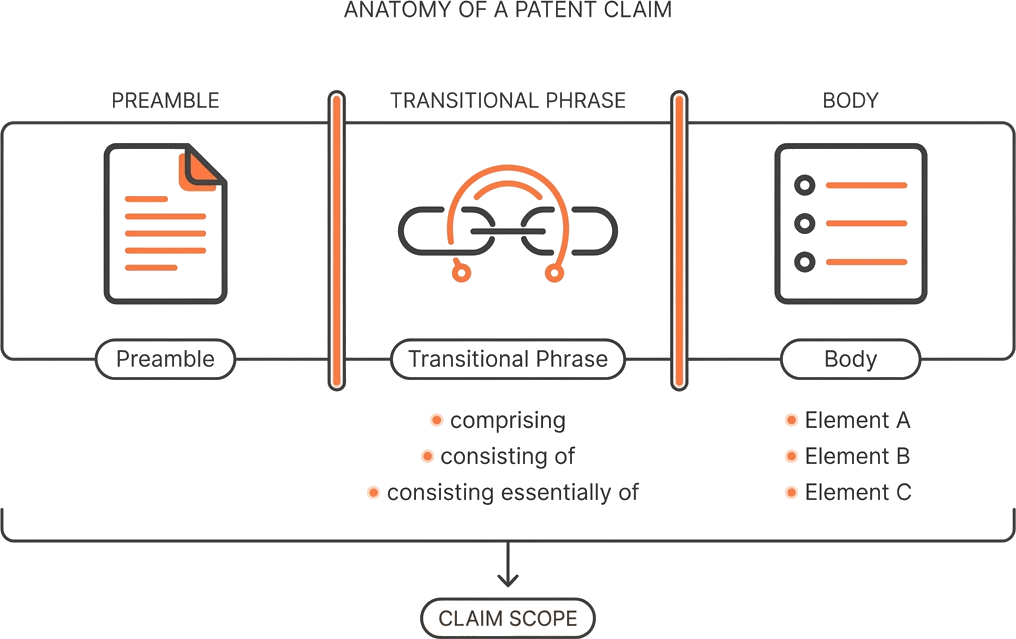
Every claim has three parts: a preamble, a transitional phrase, and a body.
Preamble
The preamble states what the invention is in general terms. Examples: “A method for detecting anomalies in network traffic,” “A system comprising,” “A pharmaceutical composition.” The preamble usually sets the context but does not always limit the claim’s scope. Whether the preamble is limiting depends on how integral it is to the invention — courts assess this case by case.
Transitional phrase
Three transitional phrases dominate patent claims, and each carries a specific legal meaning:
| Phrase | Type | Meaning |
|---|---|---|
| comprising | Open-ended | The claim covers products/methods that include the listed elements plus anything else. This is the most common phrasing and gives the broadest protection. |
| consisting of | Closed | The claim covers only the listed elements, nothing more. Adding an extra element means no infringement. |
| consisting essentially of | Semi-open | The claim covers the listed elements plus anything that does not materially affect the basic characteristics of the invention. |
The difference between “comprising” and “consisting of” can determine whether a product infringes. An accused product with elements A, B, C, and D infringes a claim “comprising A, B, and C” (because “comprising” is open-ended). It does not infringe a claim “consisting of A, B, and C” (because D is an extra element and “consisting of” is closed).
Body
The body lists the specific elements and limitations that define the invention. Each element is a building block. Each limitation constrains how those elements relate, interact, or function. In a method claim, the body describes a sequence of steps. In a system claim, it describes components and their connections.
Independent vs. Dependent Claims
Independent claims
An independent claim stands alone. It does not reference any other claim. Independent claims define the broadest scope of protection. Most patents have one to three independent claims — often one for a method, one for a system, and one for a computer-readable medium.
Claim 1 is almost always an independent claim and is often the broadest claim, so read it first.
Dependent claims
A dependent claim references an independent claim (or another dependent claim) and adds at least one additional limitation. The format is recognizable: “The method of claim 1, wherein the neural network comprises at least three convolutional layers.”
Dependent claims serve two strategic purposes. First, they provide fallback positions. If an independent claim is invalidated because prior art covers all its elements, a dependent claim with an extra limitation may survive — the prior art might not cover that additional element. Second, they document specific embodiments that the applicant wants to protect explicitly.
Why dependent claims matter for invalidation
In Inter Partes Review (IPR) proceedings at the PTAB, challengers often target independent claims because invalidating them has the broadest impact. But patent holders routinely fall back to dependent claims. If you are challenging a patent, you need to address both the independent and dependent claims. If you are defending one, your dependent claims are your safety net.
Common Claim Types
Method/process claims
These describe a sequence of steps. “A method for authenticating a user, comprising: receiving a biometric input; comparing the input to a stored template; generating an access token if the comparison exceeds a threshold.” Each step is an element. Every step must be present in the accused method for literal infringement.
System/apparatus claims
These describe components and their relationships. “A system comprising: a sensor array configured to detect infrared radiation; a processor coupled to the sensor array; a memory storing instructions that, when executed by the processor, cause the system to…” System claims are often paired with method claims covering the same invention from a different angle.
Composition claims
Common in chemistry, materials science, and pharmaceuticals. “A composition comprising: a polymer matrix; nanoparticles dispersed within the matrix at a concentration of 5-15% by weight.” Composition claims protect what something is made of, not what it does.
Means-plus-function claims
Under 35 U.S.C. §112(f), a claim element can be written as “means for [performing a function]” without specifying the structure. For example: “means for transmitting data wirelessly.” This sounds broad, but courts interpret it narrowly — the claim is limited to the specific structures described in the specification (and their equivalents) that perform that function. If the specification describes a Wi-Fi module as the “means for transmitting,” the claim does not cover Bluetooth transmission unless the specification mentions that too.
Means-plus-function claims are a trap for the unwary. They appear broad but often have narrower scope than structurally written claims.
Claim Construction in Practice
How courts interpret claim language
Before a patent infringement trial proceeds, the judge holds a Markman hearing (named after Markman v. Westview Instruments, 517 U.S. 370 (1996)) to determine what disputed claim terms mean. This is often the decisive moment in patent litigation. If a key term is construed broadly, the patent holder’s case strengthens. If narrowly, the accused infringer gains ground.
Both sides present evidence: the patent specification, prosecution history (the back-and-forth with the examiner during prosecution), technical dictionaries, and expert testimony.
Broadest reasonable interpretation vs. Phillips standard
Two different standards govern how claims are read:
Broadest reasonable interpretation (BRI) is used by the USPTO during examination of pending applications. Under BRI, each claim term is given its broadest reasonable meaning consistent with the specification. This standard makes it easier to reject claims during prosecution but harder for applicants — which is the point. The patent office wants to ensure claims are not granted more broadly than the invention warrants.
Phillips standard (from Phillips v. AWH Corp., 415 F.3d 1303 (Fed. Cir. 2005)) is used in federal district court litigation. Under Phillips, claims are construed based on their ordinary meaning to a person of ordinary skill in the art, informed by the specification, prosecution history, and (cautiously) external evidence. This standard is generally narrower than BRI and reflects how claims are actually enforced.
Since November 13, 2018, the PTAB also applies the Phillips standard in IPR and PGR proceedings (37 C.F.R. §42.100(b), as amended), bringing post-grant review in line with district court practice. (The Covered Business Method (CBM) program, which also adopted the Phillips standard, expired on September 16, 2020.) BRI now applies primarily to examination of pending applications, not to post-grant challenges of issued patents.
The practical difference: a claim examined under BRI during prosecution may be construed more narrowly when the same patent is later enforced or challenged under Phillips.
How to Read Claims Step by Step
- Read the independent claims first. Start with claim 1. Identify the preamble, transitional phrase, and each element in the body.
- Break each claim into individual elements. List them. Each element is a discrete requirement.
- Identify the limitations. What constraints does each element impose? “At least three layers” is different from “three layers.”
- Map elements to the real world. For prior art analysis, map each element to a prior art reference. For FTO, map each element to your product’s features. Every element must be accounted for.
- Check the dependent claims. They reveal what the applicant considered important variations or embodiments.
GoVeda’s Patent Chat lets you ask questions about specific claims in plain language. Open any patent in the Patent Viewer and ask: “What does claim 1 require?” or “How does claim 3 narrow claim 1?” The AI reads the full patent text and responds with citations to the relevant passages.
Disclaimer: This article is provided for general information only and does not constitute legal advice. Claim construction is case- and jurisdiction-specific — consult qualified patent counsel before drafting, amending, or enforcing claims.