From Idea to Patentability Report in 5 Minutes
A traditional patentability assessment takes one to three weeks and costs $1,500 to $4,000 depending on complexity. You describe your invention to a patent attorney or search firm, they run searches, analyze the results, and deliver a written report.
GoVeda’s AI Patentability Report compresses this process to minutes. You describe your invention, the AI searches 220M+ patents, analyzes the closest matches, and generates a structured report with a novelty verdict and actionable recommendations.
This is not a replacement for professional patent counsel. It is a first-pass assessment that tells you whether your invention has legs before you commit significant time and money to prosecution.
What Is a Patentability Report?
GoVeda’s Patentability Report is an AI-generated Novelty Analysis Report. It evaluates your invention against relevant prior art and assesses whether the invention is likely novel and non-obvious.
The report answers the question every inventor asks first: “Has someone already done this?”
Step-by-Step Walkthrough
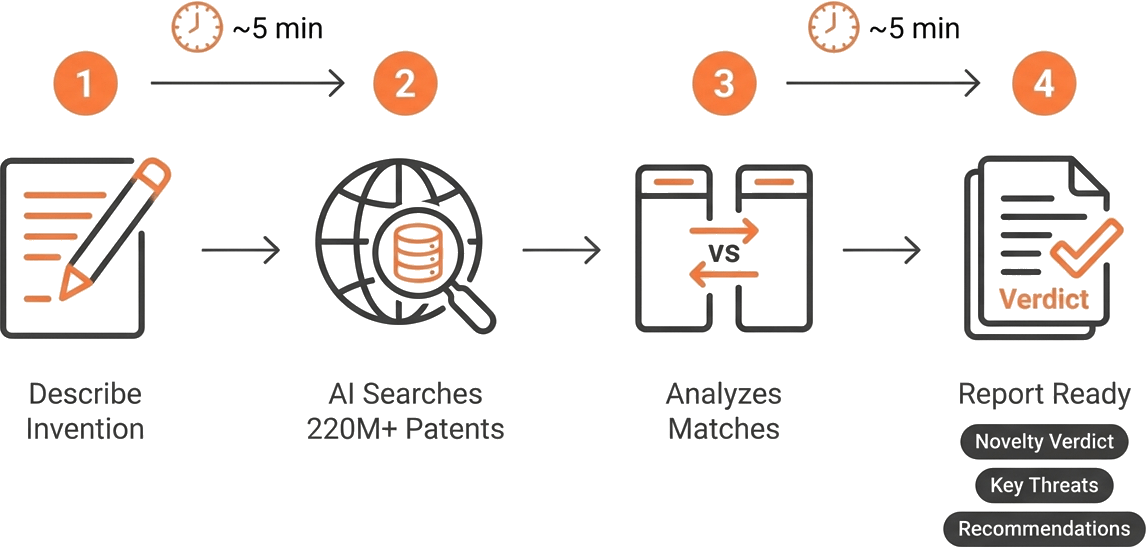
Step 1 — Describe your invention
Write a plain-language description of your invention. Include:
- What it does — the function or problem it solves
- How it works — the technical mechanism, architecture, or process
- What is new — what distinguishes your approach from existing solutions
The more specific you are, the better the results. “A new kind of battery” produces vague results. “A lithium-ion battery cell with a solid-state electrolyte layer composed of garnet-type Li7La3Zr2O12, deposited via aerosol deposition onto a lithium metal anode, enabling operation at temperatures up to 80°C without separator degradation” gives the AI enough signal to find the most relevant prior art.
Step 2 — GoVeda searches 220M+ patents
The system converts your description into a semantic query and searches across 220M+ patent documents in 108 jurisdictions. The search captures patents that describe similar concepts regardless of the specific terminology they use — including patents filed in other languages.
Step 3 — AI analyzes top matches
For each of the most relevant results, the AI compares the prior art patent against your invention description. It identifies where the prior art overlaps with your invention and where it diverges. This comparison forms the basis of the novelty assessment.
Step 4 — Report generated
The full report is typically ready in three to five minutes. You receive a notification when it is complete.
What’s in the Report
Executive summary with novelty verdict
A one-paragraph assessment of your invention’s novelty, summarizing the overall landscape and the most significant prior art findings. This is the “bottom line” — read this first.
Key threats
The prior art references most likely to challenge patentability, summarized as a bulleted list of specific findings. These highlight the most significant overlaps between your invention and existing patents.
Query analysis
An overview of how the system interpreted your invention description, including the identified technical domain, relevant CPC/IPC classification codes, and the novelty features extracted from your description. This context helps you verify that the search targeted the right technology area.
Per-patent comparison
For each analyzed reference, a structured comparison mapping your invention’s features against the prior art’s disclosures. This is similar to the claim charting used in professional patentability assessments, adapted for AI-generated analysis.
Formatted citations and next-step recommendations
Every reference is cited with its publication number, title, and a link to the full patent on GoVeda. The report concludes with specific recommendations: proceed with filing, refine claims to avoid specific prior art, or reconsider the invention direction.
Free vs. Pro Reports
Free tier: You can generate reports and see the executive summary, query analysis, and the first prior art patent. Remaining patents are blurred and patent identifiers are hidden until you upgrade.
Pro tier: Full, unredacted analysis with all per-patent comparisons, detailed threat assessments, and complete recommendations. Pro reports are the ones you share with your patent attorney.
When to Use a Patentability Report
Before filing a patent application
The most common use case. Run a report before engaging your attorney. If the report shows strong prior art overlap, you save the cost of a doomed application. If the landscape is clear, you go into the filing process with confidence and a head start on the prior art analysis.
Early-stage R&D validation
Before committing significant engineering resources to developing an invention, check whether the concept is patentable. If three companies already hold patents on the same approach, you may want to pivot to a differentiated method before investing further.
Investor due diligence
Investors evaluating a startup’s technology want to know whether the IP is defensible. A patentability report provides a fast, structured assessment of the invention’s novelty relative to existing patents. It is not a legal opinion, but it flags obvious risks early.
Before a provisional filing
If you are filing a US provisional application to establish a priority date, a quick patentability check helps you understand the landscape and draft the provisional with the right focus — emphasizing the aspects of your invention that are most clearly novel.
Generate your first report on GoVeda →
Disclaimer: AI-generated patentability reports are for informational purposes only and do not constitute legal advice. Automated analysis may not capture all relevant prior art or legal nuances — consult qualified patent counsel before making filing or prosecution decisions.