Freedom-to-Operate (FTO) Analysis: What It Is and How to Do It
A patentability search asks whether your invention is new. A freedom-to-operate analysis asks whether your product will get you sued.
These two exercises get confused constantly, and the confusion is expensive. Companies run a prior art search, find nothing relevant, and assume they are clear to launch. They are not. A clean patentability search says nothing about whether someone else’s granted patent covers your product. FTO analysis fills that gap.
FTO vs. Patentability Search
| Patentability Search | FTO Analysis | |
|---|---|---|
| Core question | Can I get a patent on this invention? | Can I sell this product without infringing? |
| What you analyze | All prior art (including expired patents) | Only active, in-force patent claims |
| Patent status | Doesn’t matter (even expired patents count) | Critical (only enforceable patents matter) |
| Focus | Your invention’s novelty and non-obviousness | Your product’s features vs. others’ claims |
| Legal consequence | Patent rejection (if not novel) | Damages, and possibly an injunction (if infringing) |
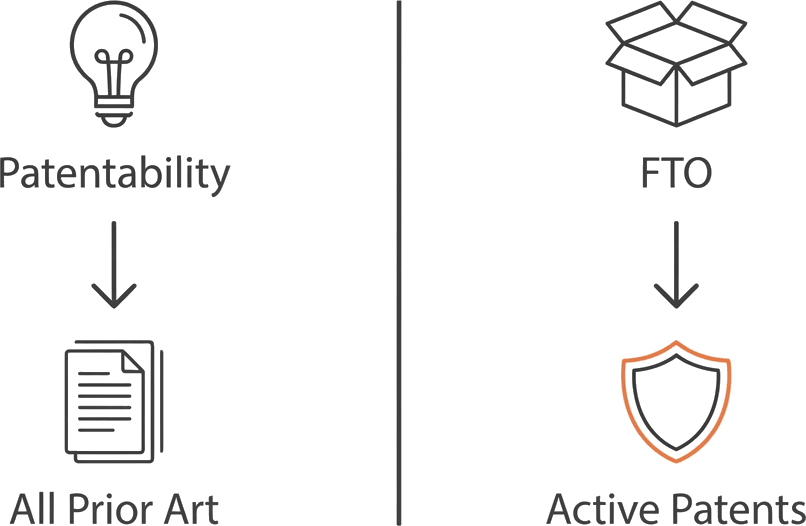
These are fundamentally different exercises. A patentability search that found no prior art tells you nothing about infringement risk. You could have a perfectly novel invention that still lands squarely within the claims of someone else’s active patent.
When You Need an FTO Analysis
Before product launch or market entry
This is the most common trigger. If you are about to manufacture, sell, or import a product, you need to know whether it infringes any in-force patents in your target markets. The cost of an FTO study before launch is a fraction of what you will pay in litigation after. Under 35 U.S.C. §284, damages for patent infringement can include lost profits and reasonable royalties, and a court may increase damages up to three times the amount found for willful infringement. In exceptional cases, the court may also award reasonable attorney fees to the prevailing party under 35 U.S.C. §285.
Before licensing negotiations
If you are negotiating a license from a patent holder, an FTO analysis tells you which of their claims actually read on your product. Without this, you are negotiating blind. You may end up paying royalties on patents you do not infringe, or failing to license the ones you do.
During M&A due diligence
Acquirers routinely commission FTO analyses on the target company’s core products. Undisclosed infringement risk can destroy deal value. If the target’s flagship product infringes a competitor’s patent, the acquirer inherits that liability.
Before manufacturing in a new jurisdiction
Patents are territorial. A product that is clear in the United States may infringe a European patent (EPC Art. 69 defines the scope of protection; Art. 64 governs the rights conferred in each designated state). Each new jurisdiction requires its own FTO assessment. China, Japan, South Korea, and Germany are the most common expansion markets where companies discover new patent exposure.
How to Conduct an FTO Analysis (6 Steps)

Step 1: Define product or process features precisely
Break your product down into its constituent technical features. Be specific. “AI-powered image classifier” is not enough. You need: the type of model architecture, the training data domain, the input format, the output classification scheme, and every other technical element that could map to a patent claim. If you cannot describe exactly what your product does at a technical level, you cannot chart it against claims.
Step 2: Search for relevant patents
Search using a combination of semantic search and patent classification codes (CPC/IPC). Start with your product description in plain language to catch patents that use different terminology. Then search by classification to find patents in the same technology area that your keyword or semantic queries may have missed. Focus on granted patents in your target jurisdictions, but flag published applications too. A pending application can issue as a patent at any time.
Step 3: Filter to in-force patents
Not every granted patent is enforceable. Check each one: Is it still within its term (generally 20 years from filing under 35 U.S.C. §154)? Have maintenance fees been paid (37 C.F.R. §1.362)? Has it been invalidated, disclaimed, or abandoned? Only patents that are currently in force pose infringement risk. Expired patents can be safely ignored for FTO purposes, even though they remain relevant as prior art for patentability.
Step 4: Claim charting
This is the core of FTO analysis. For each relevant patent, map every element of the independent claims against your product’s features. Every element must be present in your product for there to be literal infringement. Here is a simplified example:
| Claim Element (Patent US10,XXX,XXX, Claim 1) | Your Product Feature | Match? |
|---|---|---|
| ”A method for classifying images…” | Image classification module | Yes |
| ”…using a convolutional neural network…” | Uses ResNet-50 (a CNN) | Yes |
| ”…wherein the network is trained on medical imaging data” | Trained on satellite imagery | No |
| Result | No literal infringement (missing element 3) |
One missing element is enough to avoid literal infringement. But check whether the doctrine of equivalents could still apply. Under this doctrine (articulated in Graver Tank & Manufacturing Co. v. Linde Air Products Co., 339 U.S. 605 (1950) and reaffirmed in Warner-Jenkinson Co. v. Hilton Davis Chemical Co., 520 U.S. 17 (1997)), a court can find infringement even when an element is not literally met, if the substitute performs substantially the same function in substantially the same way to achieve substantially the same result. “Satellite imagery” vs. “medical imaging data” is likely a real distinction. “JPEG images” vs. “image files” probably is not.
Step 5: Risk assessment
Categorize each identified patent by risk level. High risk means your product maps to every claim element with no clear design-around path. Medium risk means most elements match but one or two are arguable. Low risk means significant claim elements are clearly absent. Document the rationale for each rating. This becomes the basis for business decisions.
Step 6: Mitigation strategies
For each high-risk or medium-risk patent, you have four options.
Design around the patent by modifying your product to avoid the claim elements. This is the cleanest solution but requires re-engineering effort and its own round of claim charting to confirm the redesign actually clears the claims.
License the patent. Sometimes the fastest path, especially when the patent holder is willing to negotiate reasonable terms.
Challenge the patent’s validity. If you can find prior art that the original examiner missed, you may be able to invalidate the blocking claims through Inter Partes Review (IPR) before the PTAB or opposition proceedings at the EPO (EPC Art. 99). A patent glossary can help you navigate the terminology of these proceedings.
Accept the risk. For low-probability scenarios, some companies choose to proceed and deal with infringement claims if they arise. This is a business judgment, not a legal recommendation.
Running an FTO Analysis on GoVeda
The six steps above describe what an FTO analysis looks like done by hand. Done thoroughly, they take a small team several weeks per jurisdiction. GoVeda’s FTO tool (currently in Beta) compresses the same workflow into roughly an hour by automating the search, screening, and claim-charting work, leaving the judgment calls to you and your counsel.
What you provide
Start at goveda.com , select FTO as the report mode, and paste a product description (at least 30 characters). You can attach product specs, technical drawings, or whitepapers as PDF or DOCX. From there, an agent walks you through five fields:
- Product name. Extracted from your description for you to confirm or edit.
- Product type. One of twelve categories (device, medical device, software, method, composition, system, semiconductor, telecom, pharmaceutical, service, combination, other).
- Commercial start date. Patents that expire before this date are excluded automatically.
- Marketing jurisdictions. Choose from 51 options (US, EP, JP, CN, GB, DE, and others).
- Manufacturing jurisdictions. Only asked if these differ from where you sell.
What you get back
A 14-chapter report that maps onto the manual steps above. Steps 4 through 6 become:
- Claim charts (Step 4). Every independent claim of every relevant patent is broken into elements, each element mapped to a feature of your product, and each match flagged as Met, Not Met, or Ambiguous. Literal infringement risk is rated alongside a doctrine-of-equivalents assessment.
- Risk heatmap (Step 5). Each blocking patent gets a multi-dimensional score: technical overlap, geographic overlap, remaining term, and litigation propensity, rolled up into an overall rating from Free to Critical. Per-jurisdiction rollups show where exposure concentrates.
- Design-around options (Step 6). For each high- or medium-risk patent, two to five concrete redesign strategies, each scored on technical feasibility (1–5) and performance impact (1–5), with the engineering evidence you would want to preserve.
The report also covers ground the manual 6-step process tends to gloss over. A validity analysis chapter lists potential invalidity arguments per blocking patent, with strength ratings and search directions. A search methodology chapter shows the screening funnel: how many patents started, how many were filtered out at each stage, and why. The whole report exports as a PDF.
Why it’s faster
A two-pass relevance gate filters out low-relevance patents before any claim charting happens, so the slow work only runs on patents that plausibly read on your product. All 51 jurisdictions get searched in one pass, and patent families are deduplicated automatically, so you analyze each invention once rather than once per filing.
This is AI-assisted analysis, and the product is in Beta. Edge cases in claim construction, doctrine-of-equivalents calls, and litigation risk weighting still need a qualified patent attorney’s review. The tool gives you a defensible first draft and a much shorter list to dig into, not a final legal opinion.
GoVeda’s FTO tool is currently in Beta. Get started at goveda.com by selecting FTO mode.
Common Pitfalls
Finding no patents does not mean you have freedom to operate. It means your search may not have been thorough enough. Patent databases are enormous, terminology is inconsistent across decades and jurisdictions, and a single missed reference can become a multimillion-dollar problem.
Checking only one jurisdiction is a common and expensive mistake. A US-only search leaves you exposed in every other market where you sell, manufacture, or import. Patents filed at the EPO, CNIPA, JPO, and KIPO cover products and methods that may look nothing like what you found in US filings.
Ignoring pending applications is dangerous. A published application (pre-grant) can issue as a patent at any time. If you launch a product while an application is pending and it later grants with claims covering your product, you face infringement liability from the date the patent issues, and potentially provisional rights under 35 U.S.C. §154(d) dating back to the application’s publication.
Treating FTO as a one-time exercise is the final trap. New patents issue every week. Competitors file continuations. Claims get amended during prosecution. An FTO analysis has a shelf life. Revisit it at regular intervals, especially before major product milestones.
Disclaimer: This article is provided for general information only and does not constitute legal advice. Freedom-to-operate analysis is highly fact- and jurisdiction-specific. Consult qualified patent counsel before relying on any of the statutes, cases, or strategies discussed here to make launch, licensing, or litigation decisions.