How to Conduct a Patentability Search: A Step-by-Step Guide
A patentability search — also called a novelty search — determines whether your invention is new enough to warrant a patent application. It is the first real checkpoint in the patent process, and the one most often skipped or done poorly.
The cost of a professional patentability search ranges from $1,500 to $5,000, depending on the technology area. The cost of filing a patent application on an invention that turns out to be old ranges from $10,000 to $25,000 in wasted attorney fees, examination fees, and a year or more of waiting. The search is the cheaper mistake to avoid.
What Is a Patentability Search?
A patentability search asks two questions:
- Novelty — Has this exact invention been disclosed before? (35 U.S.C. §102)
- Non-obviousness — Would a person skilled in the art consider this invention an obvious combination of known elements? (35 U.S.C. §103)
This is different from a freedom-to-operate (FTO) analysis. A patentability search looks at all prior art — including expired patents, academic papers, and public disclosures — to assess whether your invention is new. An FTO analysis looks only at active, in-force patents to assess whether your product would infringe. The two analyses use different datasets, different methods, and answer different questions.
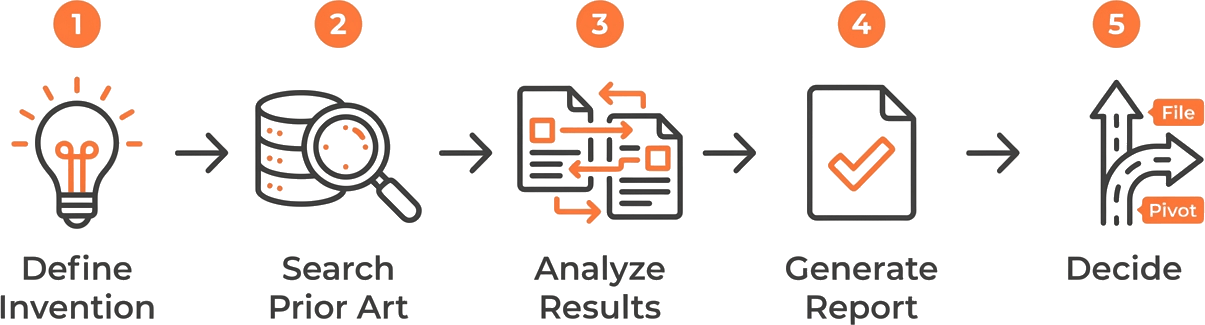
Step 1 — Define Your Invention Clearly
Before searching, you need to know exactly what you are searching for. Write a concise technical description of your invention in two to three sentences. Then identify the novel features — what specifically is new about your approach compared to existing solutions?
This is harder than it sounds. Most inventors describe their invention too broadly (“an AI system that detects fraud”) or focus on the wrong aspects (“it uses a neural network” — so does everything else). The description should focus on what distinguishes your invention from what already exists. What is the specific mechanism, architecture, process, or combination that you believe is new?
If you cannot articulate the novel features in two to three sentences, your invention concept is not yet sharp enough for a productive search.
Step 2 — Search for Prior Art
Semantic search
Start with a plain-language description of your invention on GoVeda. Describe what it does, how it works, and what problem it solves. The semantic search engine converts your description into a meaning vector and finds patents with similar concepts, regardless of the specific terminology they use.
This is the discovery phase. You are looking for the closest prior art — the documents that would be most threatening to your patent application.
Refine with discovered terminology
Review the top semantic results. Note the terminology they use — the specific technical terms, the way they describe similar mechanisms. Use these terms to refine your semantic queries and drill deeper into the most relevant areas.
If your semantic search for “a method for detecting counterfeit products using spectral fingerprints of packaging materials” returns patents that use terms like “spectroscopic authentication” or “material signature verification,” incorporate those terms into follow-up searches for more targeted results.
Non-patent literature
Do not stop at patents. Academic papers, conference proceedings, technical standards, product datasheets, and open-source repositories all count as prior art. Google Scholar, IEEE Xplore, and arXiv are starting points. If a PhD thesis from 2018 describes your method, your patent application is dead on arrival regardless of what the patent databases show.
GoVeda currently focuses on patent literature search. Non-patent literature (academic papers, technical standards, etc.) is not yet covered — you will need to search those sources separately using tools like Google Scholar or IEEE Xplore.
Step 3 — Analyze the Results
Review top matches
For each highly relevant result, read the abstract and claims. Ask: does this document disclose the same invention? Does it disclose the same core mechanism? How close is it?
Use GoVeda’s Patent Chat to ask targeted questions: “Does this patent describe [your specific mechanism]?” or “What is the key technical difference between this patent’s approach and [your approach]?”
Map prior art to your invention
Create a simple mapping: list your invention’s key features in one column and the closest prior art’s features in another. Where do they overlap? Where do they differ? The differences are where your novelty lives. If every feature has a match in a single prior art reference, your invention is anticipated — not novel.
Assess non-obviousness
Novelty is necessary but not sufficient. Even if no single reference discloses your exact invention, a patent examiner can reject your application under §103 if the invention would be obvious to a person skilled in the art.
The framework comes from KSR International Co. v. Teleflex Inc., 550 U.S. 398 (2007). The Supreme Court rejected a rigid application of the Federal Circuit’s earlier TSM test (Teaching, Suggestion, Motivation), which had been read as requiring an explicit teaching, suggestion, or motivation in the prior art itself to combine references. Under KSR, the reason to combine can also come from common sense, known design needs, market demand, or the predictable use of prior art elements according to their established functions. If a combination of known elements yields predictable results, it is likely obvious.
When analyzing your results, ask: if a skilled engineer saw references A and B, would combining them to arrive at my invention be a predictable, routine step? If yes, your invention may face an obviousness rejection even though it is technically novel.
Step 4 — Generate a Patentability Report
GoVeda’s AI Patentability Report automates the analysis step. Describe your invention, and the system searches 220M+ patents, identifies the most relevant prior art, compares it to your invention, and produces a structured report including:
- Executive summary with a novelty verdict
- Key threats — the prior art most likely to block your application
- Per-patent comparison — your features mapped against each reference
- Recommendations for next steps
Reports typically generate in three to five minutes. They are not a substitute for attorney review, but they give you a strong foundation for deciding whether to invest in a full patent application.
Step 5 — Make Your Decision
The search results point toward one of three outcomes:
Strong novelty. No prior art comes close to your invention. Proceed with filing. Your patent attorney can draft claims with confidence that the prior art landscape is clear.
Partial overlap. Some elements of your invention appear in prior art, but the combination or specific implementation is new. This is the most common result. Work with your attorney to draft claims that emphasize the novel aspects and avoid the areas where prior art is strong.
Full anticipation. A single prior art reference describes your invention almost exactly. Do not file. Either pivot the invention to address the gap, or move on to the next idea. Filing a patent application on an anticipated invention wastes money and time.
Run your first patentability report on GoVeda →
Disclaimer: This article is provided for general information only and does not constitute legal advice. A patentability search informs but does not substitute for a legal opinion — consult qualified patent counsel before filing, amending, or abandoning an application.