Patent Search Strategies: Keyword vs. Semantic vs. Classification
No single search method finds everything. Experienced patent searchers know this, but many inventors and engineers default to one approach — usually keyword search — and stop there. The result is a search that feels thorough but misses entire categories of relevant prior art.
This article compares three primary search strategies, explains when each works best, and shows how combining them produces the most reliable results.
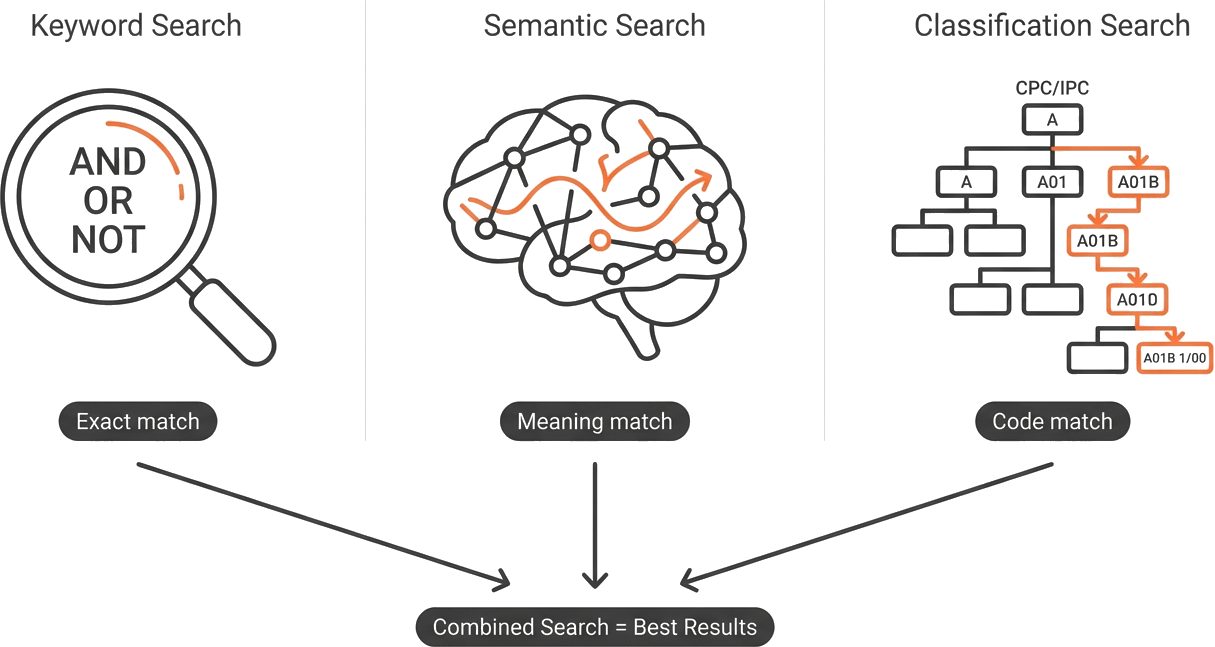
Keyword Search
How it works
Keyword search matches exact terms in patent documents using Boolean operators. A typical query looks like this: ("autonomous vehicle" OR "self-driving car") AND ("lidar" OR "laser scanner") AND NOT "drone". The search engine returns documents containing those exact strings, filtered by the Boolean logic.
Strengths
Precision is the main advantage. You control exactly what the search returns. Queries are reproducible — run the same query next month and you get the same results plus anything new. For patent prosecution, this matters. You need to document what you searched and how, especially if you need to document your search methodology for patent prosecution records.
Keyword search also works well when terminology is standardized. In pharmaceuticals, compound names are specific. In semiconductor manufacturing, process terms are consistent. When the vocabulary is stable, keyword search is efficient and reliable.
Weaknesses
The synonym problem is where keyword search breaks down. The same technology can appear under entirely different terms depending on the jurisdiction, the decade, or the author. “Autonomous driving” might be described as “self-driving,” “driverless,” “unmanned vehicle operation,” or “automatic vehicle control” — and those are just the English variations. A Chinese patent might use 自动驾驶 or 无人驾驶. A German patent might use “autonomes Fahren” or “fahrerloser Betrieb.”
You cannot construct a keyword query that anticipates every variant. Every term you miss is a gap in your search. Keyword-based patent searches typically achieve recall rates well below 100%, meaning a meaningful fraction of relevant prior art is routinely missed even by professional searchers; the gap tends to widen in emerging technology areas where terminology is still unsettled.
Semantic Search
How it works
Semantic search uses AI embedding models to convert text into numerical vectors that represent meaning. When you describe an invention in plain language — “a method for detecting road obstacles using reflected laser pulses from a rotating sensor array” — the model converts that description into a vector. It then compares that vector against pre-computed vectors for millions of patent documents and returns the closest matches by meaning, not by word overlap.
Strengths
Semantic search catches what keyword search misses. It finds patents that describe the same concept using different terminology because it matches on meaning, not strings. It handles natural language input — you do not need to construct Boolean queries or guess the right terms. And it works across languages. A search described in English can surface relevant patents filed in Chinese, Japanese, German, or Korean, because the underlying meaning vectors are language-agnostic.
For initial discovery — when you are exploring a technology area and do not yet know the dominant terminology — semantic search is the fastest path to relevant results.
Weaknesses
Precision control is limited. Semantic search may return results that are conceptually related but not technically relevant. A search for “battery thermal management” might surface patents about HVAC systems or industrial cooling that share thermal concepts but have nothing to do with batteries. You cannot easily exclude entire domains the way you can with Boolean NOT operators.
Semantic search also depends on the quality of the embedding model. Different models handle different technology domains with varying accuracy. The results are less transparent — it is harder to explain exactly why a particular document was returned.
Classification Search
How it works
Every patent is assigned one or more classification codes from hierarchical systems like CPC (Cooperative Patent Classification) or IPC (International Patent Classification). These codes organize patents by technology area. CPC code H01M 10/6556, for example, falls under the battery thermal management hierarchy and covers solid parts with flow channel passages or pipes for heat exchange. You can search for all patents assigned to a specific code or a range of codes to find everything in that technology domain.
Strengths
Classification search is systematic. When you find the right code, you get comprehensive coverage of a technology area regardless of what language or terminology the patents use. It is particularly effective for landscape analysis — mapping everything that exists in a domain. Classification codes are also stable references that patent offices and courts recognize.
Weaknesses
The learning curve is steep. Finding the right classification code requires understanding the taxonomy, which has tens of thousands of entries. Codes evolve over time — categories get split, merged, or reclassified. A code that was comprehensive five years ago may now only cover a subset of the relevant technology.
Classification is also retrospective. New technology areas may not have well-defined codes yet. If you are working at the frontier — say, neuromorphic computing or solid-state batteries — the classification system may lag behind the actual patent filings.
Head-to-Head Comparison
| Dimension | Keyword | Semantic | Classification |
|---|---|---|---|
| Speed | Fast (if you know the terms) | Fast (natural language input) | Slow (must identify correct codes) |
| Recall | Low to medium (misses synonyms) | High (catches terminology variants) | High within domain |
| Precision | High (exact match control) | Medium (may include tangential results) | Medium to high |
| Learning curve | Low (Boolean logic) | Very low (plain language) | High (taxonomy knowledge required) |
| Reproducibility | High | Medium (model-dependent) | High |
| Best for | Known terminology, targeted search | Discovery, cross-language, initial exploration | Landscape analysis, comprehensive domain coverage |
Combining Strategies for Best Results
The strongest patent searches use all three methods in sequence:
Start with semantic search to discover the landscape. Describe your invention or technology area in plain language. Review the top results to understand what terminology appears, which companies are active, and which classification codes are assigned to the most relevant patents.
Refine with keyword search to drill into specific aspects. Use the terminology you discovered in the semantic results to construct precise Boolean queries. This narrows the field to the most directly relevant documents.
Validate with classification search to check completeness. Look at the CPC/IPC codes assigned to your most relevant results. Search those codes directly to find any patents that your keyword and semantic queries may have missed.
This three-step approach — discover, refine, validate — gives you the best balance of recall and precision.
GoVeda’s semantic search lets you describe your invention in natural language and find relevant patents by meaning rather than keywords. Classification codes appear on every patent in the Patent Viewer, making it easy to pivot to code-based exploration.
Disclaimer: This article is provided for general information only and does not constitute legal advice. Patent search strategies vary by use case, jurisdiction, and technology area — consult qualified patent counsel before relying on search results for filing, licensing, or litigation decisions.